A 12-hour sequence on an LC-MS system failed at injection 74 with a 4.2% RSD on the internal standard, up from 0.8% at the start of the run. The method used 100% acetonitrile at 40 °C. The septa were standard silicone/PTFE, the same lot we had used for aqueous methods for two years. The instrument was fine. The polymer was wrong. That is the whole problem in one paragraph: the vial material is a method variable, and most labs pick it from habit rather than from the solvent list. This guide is about which HPLC vial material to use for a given solvent and temperature, and what each wrong choice does to your data.
I have run a consumables operation long enough to have shipped the wrong septa into a validated method, and long enough to have eaten the rework. What follows is the decision logic I would give a lab manager who asked me in the corridor, with the numbers I actually use.
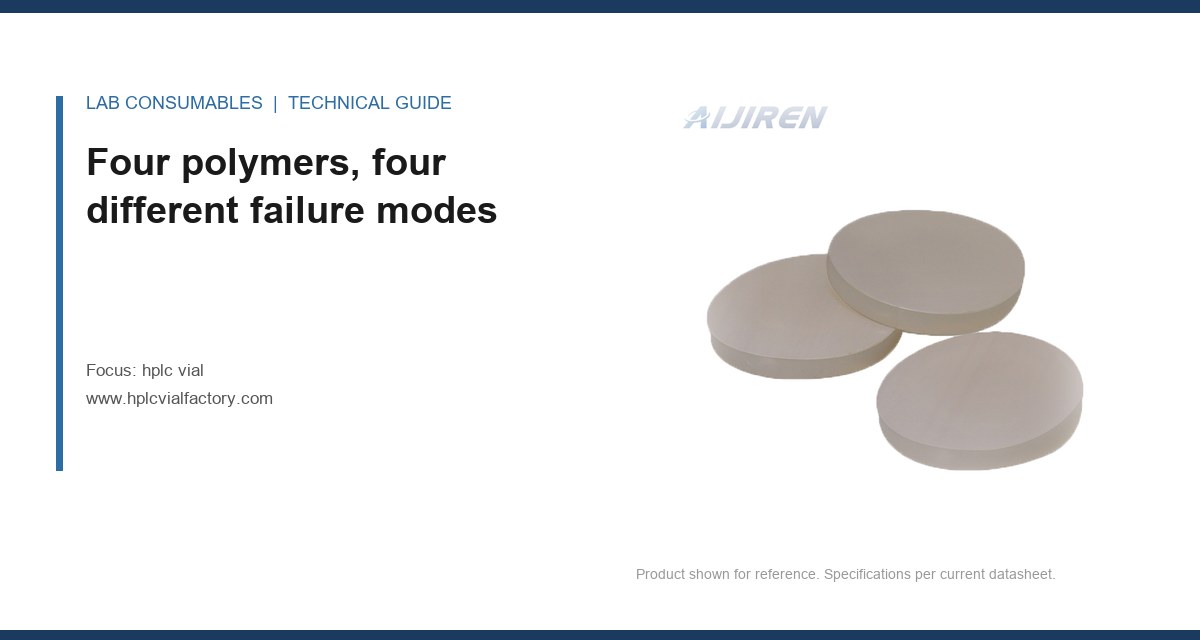
Nearly every HPLC vial closure in circulation uses one of four materials, or a laminate of two. They are not interchangeable, and they do not fail the same way. That distinction matters because a failure you can see (a split septum, a leaking cap) is recoverable. A failure you cannot see (extractables, adsorption, evaporation) corrupts the run silently.
PTFE and PTFE-faced laminate
PTFE is the default facing material for a reason. It is essentially inert to every common HPLC solvent: acetonitrile, methanol, water, THF, DMSO, dichloromethane, hexane. It holds from roughly -100 °C to +260 °C in continuous service. It has no plasticiser to leach, which is why it is the facing of choice for LC-MS and for anything with a low-level quantitation limit.
The weakness is mechanical, not chemical. PTFE is soft and cold-flows under compression. A pure PTFE septum will take a needle, but it does not reseal well after repeated punctures, and it will creep under the cap’s compression over a long sequence. That is why it is almost always laminated to silicone: the silicone provides the elastic recovery, the PTFE provides the chemical barrier. A laminate is only as good as its bond. If the facing delaminates, you get a flap of PTFE pushed into the vial neck, and the autosampler needle starts coring it.
Silicone
Silicone has excellent reseal and puncture performance. A good 1 mm silicone layer will take 50 to 100 punctures before the seal degrades noticeably. It is the elastic engine of most laminates. On its own, though, silicone is a poor barrier: it is highly permeable to solvents and to oxygen, and it swells in non-polar solvents. It also leaches low-molecular-weight siloxanes, which is a real problem on LC-MS at low mass ranges.
EPDM
EPDM (ethylene propylene diene monomer) is the workhorse for aqueous and polar systems. It is excellent against water, methanol, acetonitrile, and dilute acids and bases, and it holds up to about +120 °C to +150 °C depending on grade. It has good compression set, so it keeps sealing under a cap. It is the wrong choice for non-polar solvents (it swells in hexane, toluene, dichloromethane) and it is not a low-extractable material. For an aqueous method at ambient temperature, EPDM is often the most cost-effective closure that will actually hold.
The laminate decision
Most buyers do not choose between PTFE, silicone and EPDM. They choose between laminates: silicone/PTFE (silicone body, PTFE facing toward the sample) and EPDM/PTFE. The facing controls what touches the sample; the body controls the seal. For a method that runs both aqueous and organic mobile phases, silicone/PTFE is the general-purpose answer. For a purely aqueous method where cost matters and extractables are not critical, EPDM alone is defensible.
Solvent compatibility: the table I actually use
The table below is the working version, not the marketing version. It assumes a standard 11 mm crimp or 9 mm screw closure at ambient-to-moderate temperature. Where I say “swells”, I mean visible swelling within 24 hours of contact, which is your early warning that the seal will fail before the run ends.
| Solvent / condition | PTFE / silicone-PTFE | Silicone alone | EPDM | Failure if wrong |
|---|---|---|---|---|
| Water, buffers, dilute acid/base (pH 2-12) | Good | Fair (leaches) | Excellent | Adsorption, pH drift |
| Methanol, acetonitrile | Excellent | Good | Good | Swelling, evaporation |
| THF, DMSO, DMF | Good (PTFE facing) | Poor (swells) | Poor (swells) | Seal creep, leak |
| Dichloromethane, hexane, toluene | Good | Poor (swells badly) | Poor (swells) | Extractables, coring |
| > 60 °C aqueous | Good | Fair | Good to 120 °C | Evaporation, pressure loss |
| LC-MS, low-level quantitation | Excellent (low extractables) | Poor (siloxane background) | Fair | Baseline noise, false positives |
Two notes on reading that table. First, “good” means the material survives the exposure without a change in seal performance; it does not mean zero extractables. If your method has a limit of detection below about 1 ng/mL, you need to run a blank with the actual closure lot, not trust a compatibility chart. Second, the temperature column is where most people get caught. A septum that is fine at 25 °C is a different material at 70 °C, because permeability and creep both rise with temperature.
pH is a material selector, not a method note
I see pH treated as an afterthought in method transfer. It is not. The pH of your mobile phase and sample determines which polymers are even in the running.
- pH 2 to 12: all four materials are in play. EPDM and silicone/PTFE both work; choose on extractables and cost.
- pH below 2 (strong acid): silicone degrades; EPDM is acceptable; PTFE facing is the safe choice. Acid also attacks the glass itself, which is a separate problem, but the closure should not be the weak link.
- pH above 12 (strong base): silicone and EPDM both suffer; PTFE is the only facing I would trust for extended contact. Note that borosilicate glass also etches at high pH, so a PTFE-lined closure plus a short hold time is the practical combination.
The failure mode when you get pH wrong is usually not a dramatic leak. It is a slow change in the seal’s compression set, so the cap loosens over a long sequence and you get evaporation from the headspace. On a 2 mL fill in a 2 mL vial, losing 20 µL to evaporation over 12 hours is a 1% concentration change, which is enough to fail a system suitability check on peak area RSD.
Temperature windows and what happens at the edge
The published service temperatures are real, but they are not the same as “safe for your autosampler tray.” Here is how I think about the three temperature zones that matter in practice.
Ambient to 40 °C
This is the normal autosampler environment and almost any closure works. The dominant risk here is not temperature but time: a long sequence at ambient still loses volatiles through a permeable septum. Silicone alone is the worst offender; PTFE-faced laminates are the best.
40 °C to 80 °C (heated trays, some LC methods)
This is where EPDM earns its place for aqueous methods, and where silicone/PTFE remains the general-purpose choice. Watch for two things: seal creep under the cap, and condensation on the septum if the tray cycles. A closure that cold-flows at 60 °C will show up as a gradual rise in backpressure or a falling injection volume, not as an obvious leak.
Above 80 °C
Few HPLC methods run sample trays this hot, but headspace and some derivatisation workflows do. Here PTFE is the only facing I would specify, and I would check the cap torque after equilibration. The glass and the closure expand at different rates; a cap torqued to 1.5 in-lb at room temperature can be loose at 90 °C. Re-torque or use a closure rated for the cycle.
Two field cases where the polymer was the method
Case 1: the LC-MS baseline that climbed
Symptom: a quantitation method at 5 ng/mL started showing a rising baseline and intermittent false positives at the analyte retention time after a septum lot change. The method was 60:40 acetonitrile/water at 35 °C.
Measurement: we ran a blank injection series with three closure types and compared the m/z 371 background. The silicone-only closure gave a background roughly 8x the PTFE-faced laminate, and it grew across the sequence as the needle punctured the silicone layer. The “false positive” was a siloxane fragment, not the analyte.
Fix: switched to a silicone/PTFE laminate with the PTFE facing the sample, and added a closure blank to the system suitability. Background dropped back to the laminate baseline and the false positives disappeared. The lesson: on LC-MS, the septum is part of the blank.
Case 2: the aqueous method that lost 3% of its volume
Symptom: a validated aqueous method (10 mM phosphate buffer, pH 7.4, ambient tray) failed its 24-hour stability check. Peak areas dropped 3% between the first and last injection of a 24-hour sequence.
Measurement: we weighed a set of filled vials before and after 24 hours in the tray. The EPDM closures lost 18 to 22 mg per vial; the PTFE-faced closures lost under 4 mg. The buffer was fine; the water was leaving through the septum.
Fix: moved the method to a PTFE-faced laminate and re-ran the stability check. Loss dropped below 5 mg and the 24-hour RSD came back inside the method’s 2% limit. If the method had been a short sequence, EPDM would have been fine and cheaper. The closure has to match the hold time, not just the solvent.
Extractables: the number nobody asks for until an audit
Every polymer closure contributes something to the sample. The question is whether that something interferes with your detection. For UV methods at 254 nm, most extractables are invisible. For LC-MS, they are not. For ion chromatography, they can shift retention. This is why the USP and ICH extractable-and-leachable framework exists, and why a supplier who cannot give you a controlled extractables profile is a risk on any regulated method.
What I ask for, concretely:
- A blank chromatogram from the actual closure lot at your detection wavelength or m/z.
- The polymer grade and cure system (peroxide-cured vs platinum-cured silicone matters for extractables).
- Whether the PTFE facing is skived or molded, and its thickness (a 0.2 mm facing behaves differently from a 0.05 mm one).
- A statement of USP Class VI or equivalent biocompatibility testing if the method is regulated.
If you are sourcing closures for a regulated method, the technical resources at Hplc Septa are a reasonable starting point for the extractables conversation, and the method-specific guidance in U.S. EPA SW-846 is worth reading for waste and environmental methods where the container is part of the procedure.
The decision checklist: solvent, pH, temperature, hold time
Here is the sequence I would put on a one-page SOP for closure selection. It takes about two minutes per method and it prevents most of the failures above.
- List every solvent in the method, including the reconstitution solvent and the needle wash. The needle wash counts: a needle that sits in hexane between injections carries it into the septum.
- Note the pH range of the mobile phase and sample. Below 2 or above 12, restrict to PTFE facing.
- Note the tray temperature and the total hold time. A 24-hour sequence at 60 °C is a different requirement from a 2-hour sequence at ambient.
- Check the detection mode. LC-MS and low-level UV push you toward PTFE-facing laminates; a high-concentration UV method can tolerate EPDM.
- Confirm the closure is rated for the punctures you will make. A 96-injection sequence with a single vial needs a septum rated for at least 100 punctures; silicone/PTFE laminates are the safe choice.
- Run a blank with the actual lot before the method goes live. This is the step everyone skips and the one that catches extractables.
For the physical fit and cap torque side of the same decision, the closure selection material at Vial Closures covers the mechanical side, and the broader catalogue at Hplc Vial is where I would start for the vial-and-closure combination itself. If you are matching a closure to a specific instrument’s autosampler, the consumables documentation from Agilent and Thermo Fisher gives the tray and needle geometry you need to respect.
Where the wrong polymer shows up first in the data
You do not always get to choose the closure before the method is written. Sometimes you inherit a method and the closure is already in the SOP. In that case, here is the troubleshooting order I use, because the failure signature tells you which material is wrong before you pull the vial.
- Rising baseline or new m/z peaks: extractables. Suspect silicone-only or a degraded laminate. Run a closure blank.
- Falling peak areas over a long sequence: evaporation through a permeable septum. Suspect silicone-only or a loose cap. Weigh the vials.
- Rising backpressure or partial needle obstruction: coring or delamination. Inspect the septum for a punched flap; suspect a thin PTFE facing or a mismatched needle gauge.
- Occasional total loss of a peak: a leak at the cap. Suspect a swollen EPDM or silicone body in a non-polar solvent, or a cap that has crept at temperature.
- pH drift in an aqueous method: adsorption or leaching at the seal. Suspect silicone in a buffered system.
Each of these has a measurement attached, and the measurement is what turns a guess into a decision. The labs that get this right do not have better instincts; they weigh vials, run blanks, and count punctures.
What I would specify, method by method
If you want the short version, here is what I would put in a purchasing spec for each common method class. These are starting points, not gospel; your extractables data overrides them.
- Reversed-phase LC-UV, aqueous/organic, ambient, short sequence: EPDM or silicone/PTFE. Cost favours EPDM; extractables favour the laminate.
- Reversed-phase LC-MS, low-level quantitation: silicone/PTFE laminate, PTFE facing to the sample, platinum-cured silicone. Verify with a lot blank.
- Normal-phase or non-polar solvents (hexane, DCM, toluene): PTFE facing mandatory. No bare silicone or EPDM.
- High-pH or high-acid methods: PTFE facing, short hold time, and a check on glass attack.
- Heated tray above 60 °C: PTFE facing, and a cap torque check after equilibration (target 1.5 in-lb for a standard 11 mm crimp; verify against the closure datasheet).
- Long sequences (96+ injections per vial): laminate rated for 100 punctures, and a mid-sequence septum inspection on the first run.
One more operational note that saves money: buy the closure and the vial from the same controlled lot where you can, and keep the certificate with the method file. When an audit asks why the closure is acceptable, the answer is a lot-specific blank and a compatibility statement, not a catalogue page. The chromatography supply side of this is well covered at Chromatography Products and in the technical notes at Restek, but the responsibility for matching polymer to method stays with the lab that signs the validation report.
The decision rule is this: pick the closure from the solvent list, the pH range, the tray temperature and the hold time, in that order, and confirm with a lot-specific blank before the method goes live. If any one of those four inputs changes, the closure is a new selection, not a reorder. The polymer is not packaging. It is the part of the method that touches the sample last.
References & further reading
Related resources from our lab consumables network:
- Hplc Vial at hplcvialfactory.com
- Chromatography Products at chromatographyforsale.com
- Hplc Septa at hplcsepta.com
- Vial Closures at vialsclosures.com
External references and standards: