A procurement manager called me in March because her 9 mm screw-thread vial stockout stopped a 96-well autosampler run at 3:40 a.m. She had 14 days of on-hand cover, a nominal 21-day lead time from her distributor, and a reorder point of 10 days. On paper she was safe. In practice, the distributor’s container sat at the Port of Savannah for 9 days, her consumption spiked 40% during a method transfer, and the reorder point was set from average lead time rather than the lead-time variance. That is the whole problem in one sentence: most labs set HPLC vial MOQ lead time and reorder point planning from averages, and averages are not what runs you out of glass.
I’ve been on both sides of that phone call, as a buyer and as the guy shipping the pallets. The planning numbers for vials are not the same as for columns or reagents, because vials are consumed in bursts, bought in minimum order quantities that can be 10x your monthly use, and stored in cube that eats shelf space. This piece is about setting those numbers correctly.
Every reorder point I’ve audited that failed had the same defect: it was calculated as daily consumption × lead time. That number is the expected demand during lead time. It has no safety margin in it. It assumes every shipment arrives exactly on the nominal day and every week consumes exactly the average.
The working formula is:
ROP = (average daily consumption × average lead time in days) + Z × √(LT × σ_d² + d² × σ_LT²)
Where:
- d = average daily consumption (units/day)
- LT = average lead time (days)
- σ_d = standard deviation of daily consumption
- σ_LT = standard deviation of lead time
- Z = service factor (1.65 for 95%, 2.33 for 99%)
The second term is the safety stock. Most buyers skip it. If you’re running a regulated method with a fixed run schedule, 99% is the right service level. If you’re doing development work, 95% is fine.
Worked example: a 200-vial-per-week method
Suppose your lab consumes 200 vials per week (about 28.6/day, so d = 28.6). Your distributor’s nominal lead time is 21 days. Over the last 12 shipments, actual lead times ran 18, 22, 19, 27, 21, 20, 24, 22, 21, 19, 23, 26 days. Mean = 21.8 days, and the standard deviation works out to about 2.8 days. Daily consumption varies because the method runs in campaigns, so σ_d is roughly 9 vials/day.
Plug it in at 99% service:
ROP = (28.6 × 21.8) + 2.33 × √(21.8 × 81 + 28.6² × 7.84)
ROP = 623 + 2.33 × √(1766 + 6413)
ROP = 623 + 2.33 × 90.4
ROP = 623 + 211 = 834 vials
So the reorder point is 834, not the 601 you’d get from the naive average formula. The 233-vial difference is safety stock, and it is the only thing standing between you and a 3:40 a.m. phone call.
Where lead-time variance actually comes from
I’ve tracked this for years. The variance is rarely the manufacturer’s production time. It’s the container. A 21-day nominal lead time from a US distributor breaks down roughly as:
- Manufacturer production + QC release: 8 to 12 days
- Ocean freight (if imported): 18 to 35 days, with high variance
- Port dwell: 2 to 12 days, the single biggest variance driver
- Domestic transit: 2 to 4 days
If your supplier ships from domestic stock, your σ_LT might be 1.5 days. If they drop-ship from an overseas factory, it can be 8 days. The formula above shows why: at σ_LT = 8 days, the safety stock term nearly triples. That is the real cost of a “cheaper” offshore MOQ deal. It’s paid in safety stock, not in unit price.
MOQ is a carrying cost decision, not a discount
The minimum order quantity on an HPLC vial is usually set by the case pack, not the manufacturer’s goodwill. A standard case of 2 mL clear screw-thread vials is 100 vials per pack, 10 packs per case = 1,000 vials. Some manufacturers will break a case, most won’t. The 12×32 mm format dominates, and a pallet of those cases is 48 cases on a standard 48×40 inch pallet, about 1.1 cubic meters.
When a distributor offers a lower unit price at 10,000 vials, the question is not “how much do I save per vial.” The question is “what does holding 10,000 vials cost me per year.”
The carrying cost math
Annual carrying cost is typically 20 to 30% of inventory value: space, insurance, shrinkage, obsolescence, and the cost of capital. For vials, add a fourth item: shelf life and lot traceability. If you buy 10,000 vials and consume 200/week, you’re holding 50 weeks of stock. That is more than one lot’s worth of QC data, and if a lot is recalled or a method changes, you’re stuck with it.
Here’s the comparison for the 200/week lab above:
| Order size | Orders/year | Average inventory | Carrying cost @ 25% | Safety stock needed | Total annual carrying |
|---|---|---|---|---|---|
| 1,000 (case) | 10.4 | 500 | ~$1,250 | 834 | ~$3,335 |
| 5,000 | 2.1 | 2,500 | ~$6,250 | 834 | ~$8,335 |
| 10,000 | 1.0 | 5,000 | ~$12,500 | 834 | ~$14,585 |
(Unit cost assumed at $1.00 for the table; substitute your actual.)
The 10,000-vial MOQ saves you order-processing cost (maybe $150 per PO) but adds $11,000+ per year in carrying cost. Unless the unit price discount exceeds that, the MOQ is a bad deal. In my experience, a 10,000-vial price break is usually 8 to 12% off list, which on $10,000 of annual consumption is $800 to $1,200. That does not cover the carrying cost.
Where a big MOQ does make sense
Two cases. First, if you’re running a validated method on a fixed autosampler and the vial is qualified into the method, a larger MOQ from a single lot reduces lot-to-lot variability risk and re-qualification cost. Second, if the manufacturer’s lot release is the bottleneck and you need guaranteed availability, a blanket order with scheduled releases (e.g., 10,000 vials committed, released 1,000 at a time) gets you the price break without the carrying cost. Ask for it. Most distributors will structure it.
Setting the reorder point when MOQ exceeds your cycle stock
Here’s the trap that catches most buyers. If your MOQ (1,000) is larger than your reorder point quantity (834 – 0 = 834), you can’t reorder at the ROP without over-ordering. That’s fine, but it means the ROP is a trigger, not an order quantity. The order quantity is the MOQ. What you need to verify is that MOQ + safety stock doesn’t exceed your shelf capacity, and that the cycle time between orders is longer than the lead time.
Cycle time = MOQ ÷ daily consumption = 1,000 ÷ 28.6 = 35 days. Lead time is 21.8 days. So you have 13 days of buffer. That works. If cycle time drops below lead time, you’re ordering before the previous order arrives, which means you’re always in transit and always exposed to a single shipment delay. That’s the failure mode that hit the March caller.
Decision checklist: is your reorder point actually safe?
- Is σ_LT measured from at least 10 shipments? If not, use a conservative 1.5× nominal.
- Is the safety stock at least 2 weeks of consumption? For a 200/week lab, that’s 400 vials minimum.
- Is cycle time (MOQ ÷ daily use) longer than lead time? If not, split the MOQ or find a domestic-stock supplier.
- Is the reorder point reviewed quarterly? Consumption changes with method transfer and instrument count.
- Do you have a second qualified lot on the shelf? Single-lot dependency is a stockout waiting to happen.
- Is the vial qualified into the method? If yes, changing suppliers mid-run requires re-validation. Plan the MOQ around that.
Lead time is a distribution of outcomes, and you should buy from the middle of it
I ask every supplier for their last 12 shipment dates and compute the standard deviation myself. Most can’t produce it. The ones who can are the ones I trust with a blanket order. The ones who quote “21 days” and nothing else are telling you they don’t measure.
For planning, use the 80th percentile lead time, not the mean. If the mean is 21.8 days and σ is 2.8, the 80th percentile is about 24.2 days. Setting the ROP from the 80th percentile is a cheap way to cover most of the variance without a full statistical model. For critical methods, use the 95th percentile (26.4 days) and accept the extra carrying cost.
If you’re sourcing across multiple product lines, the Chromatography Products catalog is a useful reference for how lead times differ between vials, caps, and septa, because the septa and closures often ship from a different facility than the glass and have their own variance profile. Buy them together when you can; splitting the order doubles your exposure to a single late shipment.
Two field cases where the planning number was wrong
Case 1: the campaign consumption spike
A contract lab running EPA SW-846 methods had a reorder point of 600 vials, set from a 12-month average of 150/week. In month 9, a client sent a batch that required triplicate injections on 400 samples, and consumption jumped to 420/week for 6 weeks. The lab ran out in 11 days.
Symptom: stockout on a Wednesday, with a shipment 9 days out.
Measurement: the 6-week rolling consumption was 420/week, but the ROP was still 600 because it was reviewed annually.
Fix: switched to a monthly ROP review, added a campaign multiplier of 1.5× to safety stock when a large project is booked, and moved to a blanket order with 2,000 vials committed and 500 released monthly. The blanket order cut the effective MOQ while keeping the price break.
Case 2: the port dwell surprise
A pharma QC lab bought 20,000 vials direct from an overseas manufacturer at a 15% discount. Nominal lead time was 35 days. The first shipment took 58 days because of a port backlog. The lab had 4 weeks of cover and burned through it in 3.
Symptom: the shipment was “in transit” for 23 days with no tracking update.
Measurement: σ_LT across the first 4 shipments was 9.4 days, not the 2 days assumed in the original ROP.
Fix: recalculated ROP with the actual σ_LT, which raised it from 1,200 to 2,050 vials, and added a domestic-stock backup supplier for 20% of volume. The 15% discount did not cover the cost of the expedited air freight on two emergency orders, which came to about $4,800. That’s the real price of a long-variance supply chain.
How MOQ interacts with vial format and pack configuration
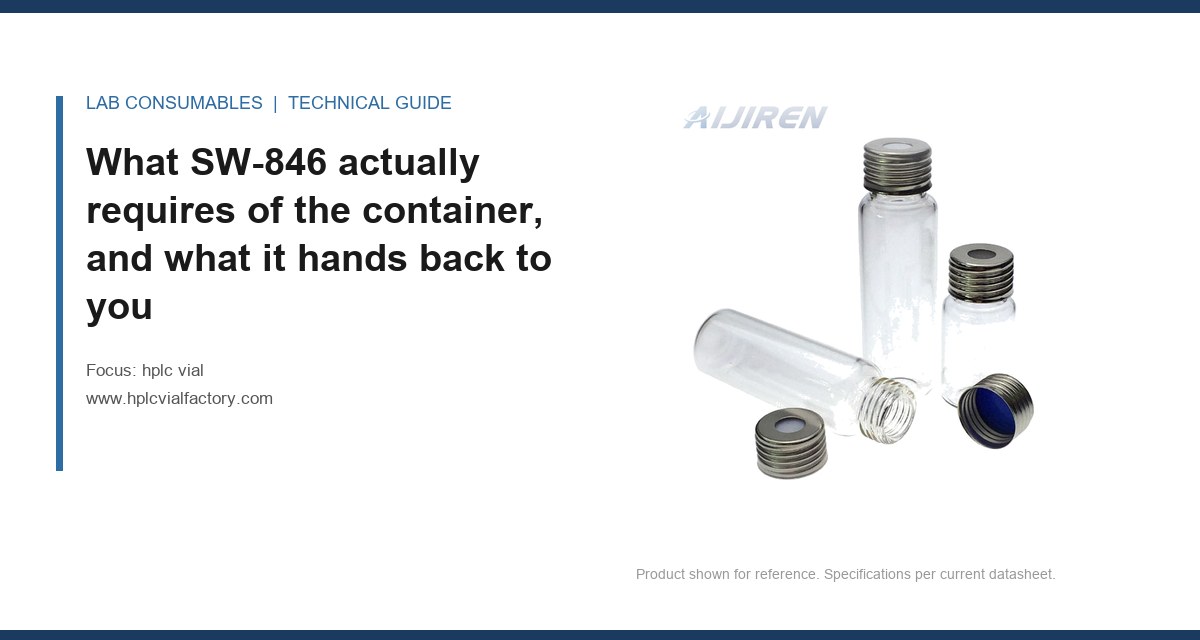
The MOQ is not just a number. It’s tied to the physical pack. A 2 mL clear HPLC vial in 12×32 mm screw-thread format ships 100 per pack. A 1.5 mL crimp-top ships 100 per pack too. But a 4 mL or 10 mL vial ships 50 or 25 per pack, which means the case quantity is smaller and the effective MOQ per unit volume is higher. If you’re planning by case, you need to know the pack count for each format you use.
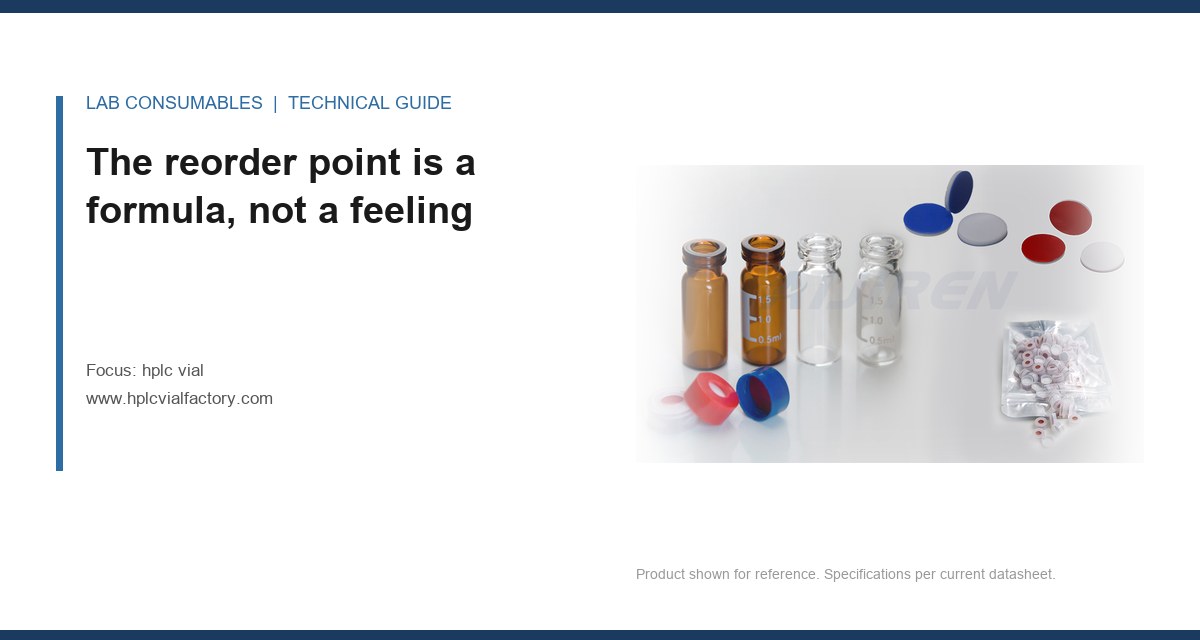
Also check the closure. A vial order that doesn’t include caps and septa is half an order. The Vial Closures range covers the 9 mm screw caps and 11 mm crimp seals that match the common formats, and the HPLC Septa page lists the silicone/PTFE and pre-slit options with their puncture ratings. A pre-slit silicone septa rated for 3 punctures at 10 psi is not the same as a non-slit PTFE-lined septa rated for 1. If your method punctures twice, the septa MOQ needs to cover double the vial count. That’s a planning number most buyers miss.
Torque, puncture count, and the storage spec that affects your ROP
Two physical specs drive your reorder point more than most buyers realize.
Torque. Screw caps should be torqued to 0.5 to 0.6 N·m (about 4.5 to 5.5 in-lb) for 9 mm thread. Over-torque deforms the septa and causes coring on the first puncture; under-torque causes evaporation and sample loss. If your lab uses a torque wrench, you’ll consume caps at a predictable rate. If it doesn’t, you’ll consume them faster because of re-capping. Plan the cap MOQ at 1.1× the vial MOQ to cover that.
Puncture count. A standard silicone/PTFE septa is rated for 1 to 3 punctures depending on needle gauge. A 22-gauge needle at 10 psi will core a non-slit septa on the second puncture. If your autosampler does duplicate injections, you need pre-slit septa or a fresh cap per injection. That changes the cap consumption rate, and therefore the cap reorder point, by a factor of 2. I’ve seen labs set the cap ROP from the vial ROP and run out of caps three weeks before the vials.
Storage. Vials should be stored at 15 to 30 °C and below 60% RH. If your storage area exceeds that, the septa can absorb moisture and the glass can develop surface haze. That’s not a reorder point issue, but it is a reason to keep the MOQ small enough that you don’t hold stock through a summer in a non-climate-controlled warehouse.
A reorder point worksheet you can run this week
Here’s the sequence I use. It takes about two hours if you have the data.
- Pull 12 months of consumption by vial format and by method. Compute daily average and standard deviation.
- Pull the last 10 to 12 shipment dates from your supplier. Compute mean and standard deviation of lead time.
- Pick a service level. 99% for validated methods, 95% for development.
- Compute ROP with the formula above. Round up to the nearest 100.
- Compute cycle time = MOQ ÷ daily consumption. If it’s less than lead time, split the MOQ or find a domestic-stock supplier.
- Compute carrying cost at 25% of inventory value and compare to the MOQ price break. If the break doesn’t cover it, buy smaller.
- Set a review cadence. Monthly for high-variance methods, quarterly for stable ones.
- Qualify a second lot and a second supplier. The reorder point only works if a shipment can actually arrive.
For method-specific reference data, the Agilent consumables and Thermo Fisher sample handling pages list the vial and septa part numbers that map to common autosampler platforms, and Restek’s technical resources have septa puncture and bleed data that’s useful when you’re setting the cap consumption rate. Use those to confirm the format before you commit to an MOQ.
The decision rule
Set the reorder point from the 80th-percentile lead time plus a safety stock of at least two weeks of consumption, recalculate it every quarter from actual shipment data, and treat any MOQ whose carrying cost exceeds the price break as a bad deal unless it comes with a blanket-order release schedule. If you can’t get the lead-time standard deviation from your supplier, assume 1.5× the nominal and plan accordingly. The number on the box is a promise; the number in your planning system is the one that keeps the autosampler running.
References & further reading
Related resources from our lab consumables network:
- Hplc Vial at hplcvialfactory.com
- Chromatography Products at chromatographyforsale.com
- Hplc Septa at hplcsepta.com
- Vial Closures at vialsclosures.com
External references and standards: